Monday, October 14, 2013

Choice – the Gift from God

I believe that God, in His/Her infinite love, gave man the freedom of choice.  He created us in His/Her own image, with the potential to grow in love and understanding, that we could be true children, who can respond to their parent by their own choice.

Unfortunately, our first human ancestors decided to go their own way, and ended up creating a world of selfishness and destruction.

“I have set before you life and death, the blessing and the curse. So choose life in order that you may live, you and your descendants.”
~ Deuteronomy 30:19

In the beginning, God set before us a commandment, not to eat of the tree of good and evil (Genesis 2:16–17).  There was only one choice to make it right. 
After men fell, during the Old Testament Age, Moses brought the 10 Commandments to give people limits.  When Jesus arrived, he opened up the New Testament Age, and he told his disciples to love God, and to love their fellow men.  Now, in the Completed Testament Age, True Parents have given us only one direction and that is “to discover God’s Heart.”  It looks like mankind came around full circle to finally start this relationship right: as spiritual beings we can be one with the all-mighty, all-knowing, omnipotent, omnipresent, and awesome God.  That means we can be like him, becoming true sons and daughters, just like Jesus, the first-born son and savior.

"For you were called to freedom, brothers.  Only do not use your freedom as an opportunity for the flesh, but through love serve one another.”
~ Galatians 5:13

Paradox of Choice
I was reading a book by the same name and learned from Barry Schwartz, the author, that the more choices we have, choice has made us not freer but more paralyzed, not happier but more dissatisfied.


He talks about the overload of choices, and how it can make some people sick and overwhelmed.  Mr. Schwartz proves that we can only experience true freedom when we can accept limits, either self-imposed through discipline or through laws or given traditions.

“Therefore be careful how you walk, not as unwise men but as wise, making the most of your time, because the days are evil. So then do not be foolish, but understand what the will of the Lord is.”
~ Ephesians 5:15-17

The Power of Choice
Man was given free will: http://www.inspiration-for-singles.com/power-of-choice.html


Choices give us motivation:

Consistently enforced limits, in the French view, make children feel safe and secure. Clear limits, they believe, actually make a child feel happier and safer—something that is congruent with my own experience as both a therapist and a parent.

"Since man fell according to his own will, God lets man make his own choice about whether to go to Satan or himself.  If the man chooses to go to God at this time then Satan must give in.  If in making the offering this person becomes completely one with the person in the Abel position and then wishes to stay on God's side, Satan has nothing to say."
~Rev. Sun Myung Moon, "Day of All Things," 6.6.1978

Even the law of the land gives us certain freedoms:

The First Amendment

The First Amendment is perhaps the most important part of the Bill of Rights. It protects five of the most basic liberties. They are freedom of religion, freedom of speech, freedom of the press, freedom of assembly, and freedom to petition the government to right wrongs. These were the guarantees that the Antifederalists missed most in the new Constitution.

Freedom of Religion
Freedom of religion means that the government may not force you to accept one set of religious beliefs, nor may it interfere with the way you worship.

Freedom of Speech
This freedom entitles American citizens to say what they think, provided they do not intentionally hurt someone else's reputation by making false accusations. Neither may they make irresponsible statements deliberately harmful to others, such as yelling, "Fire!" in a crowded theater when there is no fire. There are many issues about which Americans disagree, from child-rearing practices to baseball teams to Presidential candidates. Freedom of speech enables people to state their opinions openly to try to convince others to change their minds.

Freedom of the Press
This freedom makes it possible for Americans to keep informed about what is going on in government. It helps them to be responsible citizens. Reporters and editors can criticize the government without the risk of punishment, provided they do not deliberately tell lies. Newspapers, magazines, and books, as well as television and movie scripts, do not have to be submitted for government inspection before they are published. This censorship would violate the First Amendment.

Freedom of Assembly
This freedom makes it possible for Americans to join clubs or political parties, even if those groups represent unpopular views. Because of the First Amendment, people can join groups to promote animal rights, the nuclear freeze, or conservation. They can join groups to protest government intervention in Haiti, imported clothes and shoes, toxic wastes, or aid to Serbia or Bosnia. By sharing common interests, Americans can learn to work together. There are groups devoted to the interests of young people. Scout troops and 4-H clubs are but two examples.

Freedom to Petition
This important freedom allows people to tell the government what they think is needed. They can try to prevent the government from acting in a certain way. They can complain to the government without fear of penalty when things aren't going the way they should.
Source: http://www.scholastic.com/teachers/article/explaining-bill-rights
 
"Each man must for himself alone decide what is right and what is wrong,
which course is patriotic and which isn't.
You cannot shirk this and be a man.
To decide against your conviction is to be an unqualified and inexcusable traitor,
both to yourself and to your country."
~ Mark Twain

For myself I have reserved a simple way of making decisions. I ask myself: does my choice bring me closer to God or take me further away?  For most of the important decisions that works well for me.  It gets harder when I have to decide what to eat from a menu or what to wear for the day.  But then again, those are not life-changing choices.


Monday, October 7, 2013

O - O - Olives


When I visited my brother this past spring in Southern Spain, I got a taste of Spanish Olives.  The ones he served as tapas (appetizers) were stuffed with anchovies, oh - so delicious. The Spaniards eat them along with chorizo, a type of pork sausage or little sandwiches.  I also came to like the ones stuffed with garlic or pimientos.


Olive plantations Southern Spain
The first time I flew into Malaga, Spain, I was greeted by the olive plantations.  They looked like lush green balls, all lined up in rows, covering hill after hill.  After I tasted olives and really liked them, I did some research after coming back home, and discovered that we can buy most of them also here in America.

Here are my findings about olives:

The olive is a fruit from the  Olea europaea tree of the Oleaceae family.  In the middle of the fruit is one pit or stone.  Lilac, jasmine and forsythia are in the same plant family.  Some trees can become hundreds or even thousands of years old and still bear fruits.  The fruit is harvested in different stages as green, purple to black.  To fasten the process, commercial black olives are often treated with ferrous sulfate to achieve the black color.

Olives are grown for the oil, but the fruit also has its health benefits.

HealthBenefits of Olives 

Olives contain polyphenols which have anti-oxidant, anti-inflammatory and anti-cancer properties.  The fat content of olive’s monounsaturated fat (MUFA) can benefit lowering of high blood pressure and a healthy heart. MUFA is the healthy kind of fat compared to saturated fats and trans-fats. Olives can also help relieve pain because of oleocanthal, an anti-inflammatory compound and benefit stomach ulcers by eliminating certain bacteria. For those who are low in iron olives can raise iron count. It also contains fare amounts of copper and Vitamin E.

While the oil of the fruit is 100% fat, the fruits usually only contain about 20% fat. 

Since olives from the tree are bitter, they are cured in different methods, either water-cured, brine cured (salt water - some fermentation occurs in the process), or lye cured. The curing process adds flavor to the olives.

Interesting fact about olive trees

There are some trees in the Garden of Gethsemane (which is the Hebrew word for "gat shemanim" or olive press) which are dated back to the time of Jesus, 2000 years ago.
 
For thousands of years the olive branch has been used as a sign of peace and goodwill. This may be partly due to the fact that in early cultivation of the olive, it took decades to bear fruit for harvest, and, therefore, it was believed that anyone who planted olive groves was expecting a long and peaceful life. The symbolism is also likely related to the Biblical story of Noah’s Ark and the dove.
 
Olive oil has been used to light lamps, to create heat, is used as food, medicine and perfume.  In religious traditions the oil is used to anoint and bless people.

The Mediterranean diet is rich in olive oil and the fruits.

Spain has the highest olive production in the world. The largest olive is called “dunkey olive” and the smallest is called “bullet olive.”
 
The most popular olives are the Kalamata olives from Kalamata, Greece.

15 olives can count as your daily serving of fruits.

 Christopher Columbus brought olive oil to America, but the trees were not introduced until later.

Go and try some olives and get to love them.


Monday, September 30, 2013

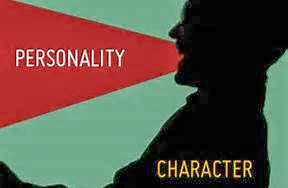
Character or Personality


When we look at character versus personality we have to accept that one cannot be without the other.  Neither one is more important than the other either. While personality primarily consists of inborn traits, character is made of learned behavior.  Let’s look at them more closely:

Character
Character is typically learned from our parents, teachers and friends. This learning comes from being taught directly or from observations of others. Character relates to attitudes and values.  It is possible to change one’s  character based on different beliefs and core values.  Although, certain habits such as lying or committing crimes are harder to change, and need mainly reform through change of environment and circumstances.

Character is trained by keeping certain disciplines such as: honor, diligence, loyalty, love, etc.

Personal character virtues are:

        Authenticity or integrity

        Dignity

        Self-control

        Virtuous

Social character virtues are:

        Honesty

        Respect

        Loyalty

        Morality

Personality
We are equipped with certain personality traits or temperaments.  Some people are outgoing and talkative, while others are introverted and keep to themselves.  Another classification is whether you tend to be task oriented or prefer social engagements. This results in people having either a domineering, influencing, steady or complying personality. Some people are born leaders while others are analytical in their thinking.  I wrote once a blog about the different personality types as laid out by Dr. Robert Rohm:

Now I ask you, what is more important? -- Character or personality?  I believe both are necessary to build a successful life. Since personality is something we are all born with we can compare it with talents, while character is something we have to attain and work for. 

Traditionally, our society paid more attention to character education while today often personality is favored.  While personality seems to unfold naturally, it takes effort to attain a solid character.  We need good role models, starting in the family, and larger community like church, school and sports.

I therefore suggest that character education has to be the internal compass which can direct us to attain our ultimate destiny. At the same time we want to let our personality unfold and share our given gift with others.

We can see in our society today what lack of character education has done.  It becomes apparent mostly in the loss of moral values.  We have lots of personality, especially those with domineering traits. 

I like to end my observation regarding character and personality with a quote from Lao Tzu:

“Watch your thoughts; they become words.
Watch your words; they become actions.
Watch your actions; they become habit.
Watch your habits; they become character.
Watch your character; it becomes your destiny.”

~ Lao Tzu Chinese Philosopher 6th century BC, wrote the Tao Te Ching (the Way).


Monday, September 23, 2013

The Bible is a Coded Message


As I was commemorating the historical events of September 18, of 1974 and 1976 this week, I started reading the message Rev. Sun Myung Moon gave on that memorable day in 1974 at Madison Square Garden in New York City. Its title is: The New Future of Christianity.

I was thinking of all the Christians and believers who interpret the bible in a literal way.  It seems so sad that so many different denominations developed over the centuries which caused a lot of divisions among believers. Rather than me dissecting this situation I like to share with you here the passage where Rev. Moon spoke about the significance of the bible as a coded message.  It is based on revelations from God and Jesus over several years:

 What is the Bible, more precisely?  The Bible has been a book of mystery.  However, the Bible contains God's message to you and me.

The Bible does not use plain language, but is written in symbols and parables. Do you know why God has presented the Bible in symbols and parables? Why did He not speak the truth clearly?
 
God has had to deal with the world of evil. Throughout the ages, God has handpicked His workers, or champions, out of this evil world. Abraham was such a champion. Noah was such a champion.
 
And God's champions were always in the utter minority in the evil world. If God revealed His strategy too openly or plainly, the enemy would use that information against God's champions. Thus, the Bible was written as a coded message, so that only God's agents or champions could decipher it.

Let me make an analogy. To protect her security, America sends out many agents overseas to collect vital information concerning potential enemies. When the home headquarters is communicating with these agents overseas, particularly in enemy territory, would they communicate openly and plainly? No. No one would be that naive. They would communicate in coded messages — secret messages — so that the enemy could not decipher them.

Throughout history, righteous people have faced nothing but suffering on this earth, simply because they were in enemy territory, and Satan did not want to have God's agents prosper. Whenever Satan's forces discovered God's representatives, they tried to destroy them.

We must realize that God has had to give His instructions in coded messages. Thus the Bible is written in symbols and parables. In a sense, the Bible is intended to be mysterious. Then how can we know the true meaning of those symbols and parables?

It is simple, in a way. If you are an agent dispatched by your headquarters, and you want to decipher a coded message, then you must either have a code book, or communicate directly with your home headquarters.

By the same token, the meaning of the symbols and parables in the Bible can only be clear when we communicate with our "home headquarters" — God. This is truly the only sure way we can know the ultimate meaning of the Bible.

Two thousand years ago our Lord Jesus Christ brought the blueprint for the Kingdom of Heaven on earth. However, he could not speak plainly about his plan even to his own disciples. Jesus spoke in figures and parables. Why?

Jesus knew the adverse circumstances in which he had to work. There was political pressure from the Roman Empire. There was the ruling monarchy, who opposed any change. And there was a strong religious system and tradition. These could all be directed against the building of the Kingdom of God.
 
Jesus came to kindle the fire of revolution in people, which would in due course change the structure and the life of the entire nation. But he could not speak plainly of any of this even to his own disciples. Instead, he had to speak in figures and parables, saying,
 
'He who has ears to hear, let him hear.' (Luke 14:35)

If you attempt to interpret the Bible literally, word for word, letter for letter, without understanding the nature of the coded message of the Bible, you are liable to make a big mistake.

Therefore, in this day, at this hour, what the Christian world needs is a revelation from God. God must reveal to us His plan; He must tell us His timetable, and give us instructions as to what to do at this time. God indeed promised that by saying, in Amos,

'Surely the Lord God does nothing, without revealing his secret to his servants the prophets.' (Amos 3:7)

Tonight I am standing here at Madison Square Garden not according to my own will, but in obedience to the divine will of God. God has called me as His instrument, to reveal His message for His present day dispensation, so that there may be a people prepared for the day of the Lord.

Tonight I am going to concentrate on the divine revelation concerning the coming of the Lord of the Second Advent — the vital issue of the Second Advent — the most important question of our time. And in order to understand this more clearly, we must first know the circumstances of the coming of Jesus Christ 2,000 years ago.

The whole message is full of new perspectives regarding the time we are living in.  Now, after almost 40 years, these ideas are even more valuable since we have in many ways repeated the same mistakes the people of Jesus’s time made 2,000 years ago.  As any sincere believer, you want to check out the rest of the story and discover for yourself “The New Future of Christianity.”

Monday, September 16, 2013

Pygmalion Effect

You may have never heard of the Pygmalion effect but there certainly has been a lot of talk recently about the Law of Attraction.  Since the book and movie “The Secret” has been published that age-old spiritual law has received a new lime-light.  In the business world they are calling it “The Law of Positive Expectation.”

So, what’s the buzz?
Thoughts create images in your head.  Those pictures produce feelings or emotions.  The vibration of these emotions will attract similar experiences.  Here it goes: positive emotions will generate positive experiences, while negative feelings will generate negative experiences.  What does that mean? You create your own life by what you imagine in your mind.  Eventually, you build your own future.

Contrary to the popular thinking that we live in a mechanical universe, the universe exists in different forms of energy, starting with the atom.  Our thoughts are a form of energy.

Where did the Pygmalion effect come from?
In Greek mythology, there was a talented sculptor named Pygmalion.  He wasn’t very successful in his love life, but he had a great imagination.  When he found a beautiful piece of ivory, he saw the form of an attractive young woman before his eyes.  He started carving and chiseling and in a short time he had created the statue of lovely young lady.  At once, Pygmalion was taken by her beauty, to the point that he put clothes on her and jewelry.  He even gave her a name: Galatea which means sleeping love.

As it is was tradition in Greece, Pygmalion went to the temple of Aphrodite, the goddess of love and beauty, and prayed for a wife just like the statue he had carved out of the piece of ivory.  When Aphrodite heard his plea, she went to see the statue of Galatea.  She was very pleased with her since she resembled the goddess. 

When Pygmalion came home from his worship, he found Galatea alive.  He fell in love with her, and they got married.  From then on, the couple went to the temple together and brought gifts of thanks to the altar of Aphrodite.  She in return blessed them with happiness and love.

And we remember the story for the lesson: whatever we expect with deep passion and imagination, it will come to pass.

The Pygmalion effect was made popular by George Bernard Shaw who wrote a play called “Pygmalion.”  It became also the known as “My Fair Lady,” a musical, where Professor Higgins takes a common flower girl from the streets of London and trains her to “become a lady,” speaking, dancing and behaving like a woman of high status.


The Power of Positive Expectations
In the 1960’s Robert Rosenthal has done experiments where he told one teacher that he had great expectation from a group of school children because of some data.  Throughout the school year, these children had great performance in all areas of study, because of the support and encouragement of the teacher.  At the end of the school year the teacher learned that the children had been randomly selected, and was surprised how well they performed.  In another experiment, high grade students were treated with no special attention and expectation.  At the end of the school year their grades showed only average results.

This seems to prove that the teachers' expectations about a student's achievement can be affected by factors having little or nothing to do with his or her ability, and yet these expectations can determine the level of achievement by confining learning opportunities to those available in one's track.

Self-Fulfilling Prophecy
Robert Merton, a 20th century sociologist, actually coined the term of self-fulfilling prophecy. In his definition, in the book Social Theory and Social Structure published in 1949, the prophecy or prediction is false but is made true by a person’s actions. In the modern sense the prophecy has neither false nor true value, but is merely a possibility that is made into probability by a person’s unconscious or conscious actions.

The self-fulfilling prophecy has also deep implications in regards to our health.  The well-known placebo effect can fit into this area which shows the power of our mind and how attitude and suggestion can influence us for better or worse.

The best steps to take advantage of the 'law of expectation' is to keep a positive attitude and stay focused on facts, and most of all trust our gut feelings in case somebody wants take advantage of our ‘innocence.’

Monday, September 9, 2013

How to Be Intimate with God?


It is the desire and the goal of all believers to experience the presence of God.  Such faith goes beyond religion and denomination. 

I have been reading a book called “The Practice of the Presence of God” by Brother Lawrence (1605-1691).
 
"We ought not to grow tired of doing little things for the love of God, who regards not the greatness of the work, but the love with which it is performed."
~ Brother Lawrence
 
As the story goes, he was born, Nicholas Herman in France in the 17th century.  He worked in the kitchen of a monastery because of injuries he had suffered during the 30-year war.  While working he continued praying and practicing to include God in every aspect of his life.  He became so proficient in his practice that people came from near and far to ask for his advice and testimony.

I know from my own personal experience that it is in the present moment (NOW) when I can meet with God.  That’s the instant when my mind and body are united and my mind is totally aware of God’s existence.  In that split second the Universal Prime Energy which is God, the Creator of all things, can manifest in me.  S/HE is also the absolute reality, eternal, self-existent and transcendent of time and space. The fundamental energy of God's being is also eternal, self-existent and absolute. It is the origin of all energies and forces that allow created beings to exist. We call this fundamental energy universal prime energy.
 
All it takes on our part is to be aware of God’s presence, sending some thoughts his way, feeling grateful, appreciating the warmth of sunshine, enjoying a delicious food, etc.

One time I was driving home from shopping.  There was an obstruction on the road and the traffic was halted completely.  Rather than complaining, I thought, oh, this is a good opportunity to think of God.  That very reflection gave me a wonderful feeling of the presence of God.

Another time I was taking a shower.  I was stiff from sleeping and really enjoyed the warm water.  As it trickled down my body, the thought came to me, that a person like me, with no special qualifications and talents could meet the Messiah.  Nobody in my family has a clue or interest in what I have learned from Him in the past 40 years.  That very idea washed away my pain for the time being and I was completely refreshed to start the day.

When I was visiting with my daughter the other day, she said, Mom, you have to try this peach.  It came from a farm stand nearby.  I tasted the fruit, and it just melted in my mouth.  It was perfectly ripe, still firm yet very juicy, and when I ate some of it, I felt deeply the love God put into creating this peach tree to provide us with delicious peaches.

Like I said before, it doesn’t take a degree to experience God’s presence, only some awareness and practice.  I hope that we all can experience God’s presence in everyday life, since nobody wants to live in a monastery or cloister.

Monday, September 2, 2013

My Labor Day Project


Labor Day 2013
As the days were getting cooler, I had planned to re-arrange the raspberries in my yard.  Since I didn’t have a good harvest for a few years, I decided to replant the whole patch.  My plants are all summer-bearing raspberries.  As the rest of my garden is in raised beds, I started to build boxes for the raspberries as well. 
Spring 2011


Here are the instructions which I followed:


Two boxes were done in the spring.  When I filled the boxes, I used topsoil, fertilizer 10-10-10, Acidifier for soil, some peat moss, and compost from my garden. 
The two rows on the left were the spring-planted, and they showed a little better yield than the other side (right row).  When I replanted the right side this fall, I cut the canes back to about 12-15 inches, with just a few leaves remaining on the canes.  I discarded all the old canes (brown and woodsy), and any plant which looked meek. 

With all the work, I hope that next year’s harvest will be plentiful again.